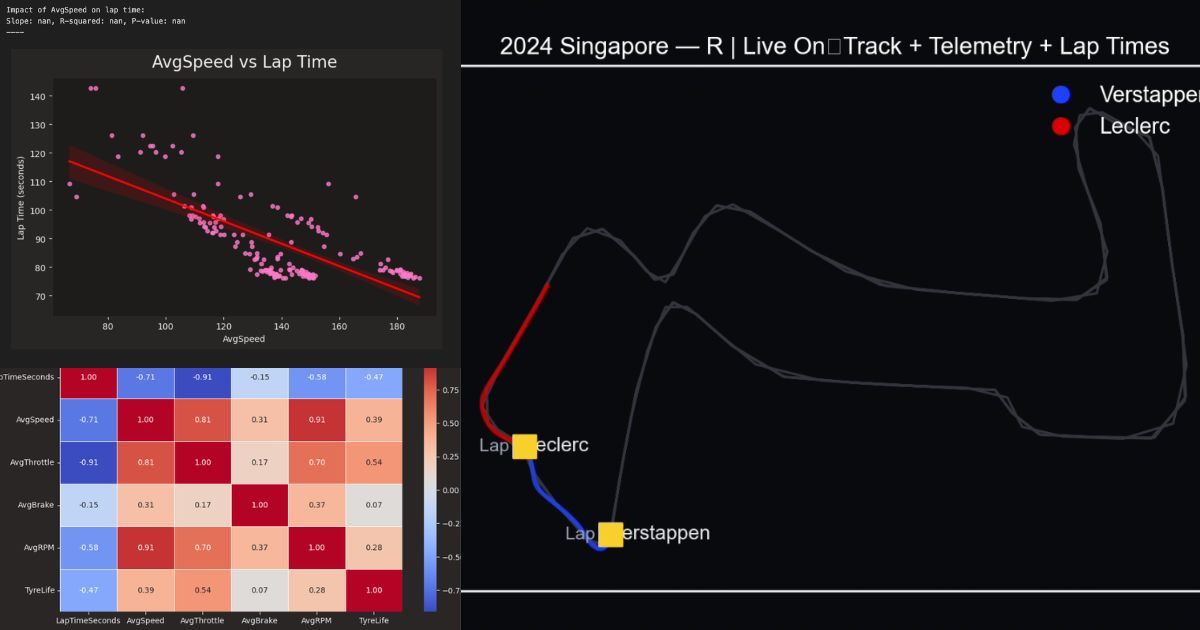
Project case study

F1 Strategy Simulation & Tyre Degradation

A modelling and simulation project exploring tyre degradation, lap-time trends, driver behaviour, weather effects, and race strategy comparison using F1 telemetry and session data.

Problem

Race strategy depends on uncertain variables: tyre degradation, fuel load, track evolution, weather, driver behaviour, traffic, and pit timing. The goal was to explore how historical practice, qualifying, race, and telemetry data can support strategy comparison.

Why it matters

The project is a compact example of decision-support modelling: combining predictions and domain logic to compare possible actions, rather than only predicting a single outcome.

Project flow

A simplified view of how the project moves from data and domain logic to usable outputs.

1. Prepare session data — clean laps, weather, tyre, and driver/session information
2. Model degradation — estimate how tyre age, compound, conditions, and driver behaviour affect lap time
3. Generate strategies — create possible stint and pit stop combinations
4. Simulate outcomes — compare predicted race time, degradation impact, and strategy trade-offs
5. Compare to reality — evaluate simulated strategies against actual race outcomes where possible

Inputs

  • Lap times
  • Tyre compound and tyre age
  • Weather and track conditions
  • Driver/session data
  • Telemetry-derived features

Methods

  • Feature engineering
  • Regression / predictive modelling
  • Strategy generation
  • Simulation logic
  • Scenario comparison

What it demonstrates

  • Decision-support thinking
  • Handling uncertainty
  • Domain-specific modelling
  • Time-series analysis
  • Interpretable outputs

What I learned

This project strengthened my understanding of the difference between modelling and decision support. A useful system must not only predict performance, but also explain trade-offs and support comparison between possible actions.

Next steps

Useful improvements would include uncertainty bands, confidence thresholds, better validation against historical races, improved driver-specific models, and a dashboard for exploring strategy scenarios interactively.